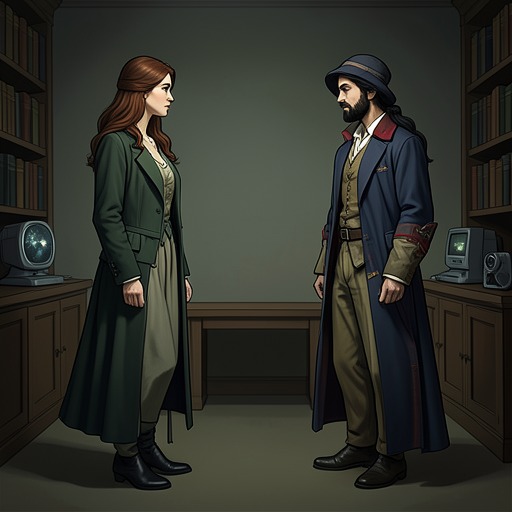
The opposition between Mookse and Gripes
Finnegans WakeThe opposition between Mookse and Gripes is a comic, asymmetrical encounter in which a grandly self-authorizing figure confronts a dependent, querulous counterpart. Their meeting at a stream becomes an exchange over status, belonging, and the possibility of yielding; Mookse answers Gripes’s appeal with pronouncements and a display of learning, while Gripes refuses to surrender what he calls his own. The contest persists after the speakers fall into darkness, and its ending disperses rather than resolves them. As a parable embedded in a book preoccupied with unstable texts and identities, their opposition makes antagonism feel at once personal, social, and cyclical.
The encounter at the stream
The episode is introduced as “The Mookse and The Gripes.” Mookse leaves his enclosed residence and walks out carrying his father’s sword; after a short distance he reaches a stream near the turning of the Shinshone Lanteran. The water is described as a small, shallow stream, and the narration gives it a voice of its own. On the opposite bank Mookse sees Gripes, who is presented as diminished and in difficulty. The geography immediately establishes the pair as counterparts divided by water, while the speech that follows turns the crossing into a contest over how each should be recognized.
Gripes greets Mookse deferentially and asks him to explain everything, including a series of paired names and abstractions. The address is simultaneously a plea for instruction and a bid to draw Mookse into conversation. Mookse first rebuffs him with contempt, calling attention to the supposed inferiority of the petitioner and summoning his own followers to stand behind him. The exchange sets the unequal terms of their relation: Gripes seeks access and acknowledgment; Mookse treats the request as an occasion to affirm rank.
Authority, dependence, and refusal
Mookse’s manner changes from anger to a calculatedly genial, ceremonious tone. He proposes that each be measured against the other and asks whether their couple of hours together are too much for Gripes. Beneath the politeness, the challenge is a demand for submission. Gripes answers that he has been considering it but cannot give himself up: his tumble belongs to him, and his particular place cannot be fitted into a single measure. The refusal is limited and plaintive rather than triumphant, but it gives Gripes a claim to self-possession that Mookse’s superior posture cannot simply erase.
Mookse then declares that he cannot save Gripes from being killed and presents his own side as secure. He speaks from a position of jurisdiction, framing the encounter as a matter he can pronounce upon rather than a relationship requiring mutual accommodation. His long, learned-sounding demonstration draws on a crowded procession of authorities, systems, and texts. The performance makes knowledge part of his dominance: instead of answering Gripes on equal terms, Mookse surrounds the exchange with the weight of accumulated learning. Yet the narration’s extravagant language also makes the display unstable and comic; authority is asserted at such length that its performance becomes visible in its own right.
A conflict without a stable victory
The pair’s exchange shifts from threats and claims to a future-oriented contest. Mookse predicts that after a thousand years Gripes will be aligned with the world; Gripes replies that after a thousand years Mookse may be even more troubled. Mookse then imagines both as among the first of the last, while Gripes hopes that they will not even be the last of the first when a veiled horror arrives. Neither statement establishes a final result. Their competing predictions instead extend the dispute into an uncertain future, where status and defeat may be reversed or rendered meaningless.
The narration eventually says that they “viterberated each other,” comparing their confrontation to opposed creatures. The struggle thus becomes more than a disagreement expressed in dialogue: it is represented as a reciprocal clash, with neither side shown to have conclusively overcome the other. The sequence does not supply a clean victory, reconciliation, or settlement before the scene’s attention turns elsewhere.
Dusk, separation, and recurrence
As evening deepens, the pair’s capacities become divided and incomplete. Mookse can see but cannot hear well; Gripes can hear but cannot see well. They cease speaking, yet each remains oriented toward a possible continuation: Mookse thinks of what he may fathom tomorrow, while Gripes imagines an escape if fortune allows. Darkness does not unite them or end their disagreement; it interrupts their ability to apprehend the other and leaves their opposing expectations in place.
Two women then arrive at opposite banks and carry Mookse and Gripes away to separate unseen dwellings. The narration treats the outcomes asymmetrically: Mookse is described as having had reason, while Gripes is said to have got it wrong, and the story generalizes Gripes’s error as characteristic of what he always was and will be. Even so, the pair are not brought together for a final judgment. After their removal, only an elm tree and a stone remain. The episode’s last movement shifts to Nuvoletta, whose disappearance and falling tear feed the stream that becomes a river; the water continues to move onward. The antagonists’ separation therefore sits within a larger pattern of disappearance and flow, rather than closing their conflict with a definitive verdict.
Narrative and textual significance
The episode makes opposition legible through contrasts—authority and vulnerability, sight and hearing, secure ground and exposed bank—while resisting a simple moral resolution. Mookse’s confidence and Gripes’s dependence are sharply unequal, but Gripes’s refusal to surrender himself prevents the relation from becoming mere submission. Their speeches also expose how claims to authority are made: Mookse invokes rank and learning, while Gripes answers with persistence and a limited assertion of ownership over his own condition.
Elsewhere the book foregrounds the difficulty of determining who made a text, how marks should be read, and how damaged or ambiguous documents acquire meaning. That concern offers a useful context for this episode’s shifting names, elaborate verbal performances, and unstable balance of understanding. Here, even perception is divided between the opponents, and the apparent result is supplied by a narration that declares one right and the other wrong without allowing their exchange to settle the matter. Their opposition survives as a pattern of contest, separation, and anticipated return, not as a conflict whose terms have been permanently decided.